Assurance Knowledge Platform Ontology Architecture Specification

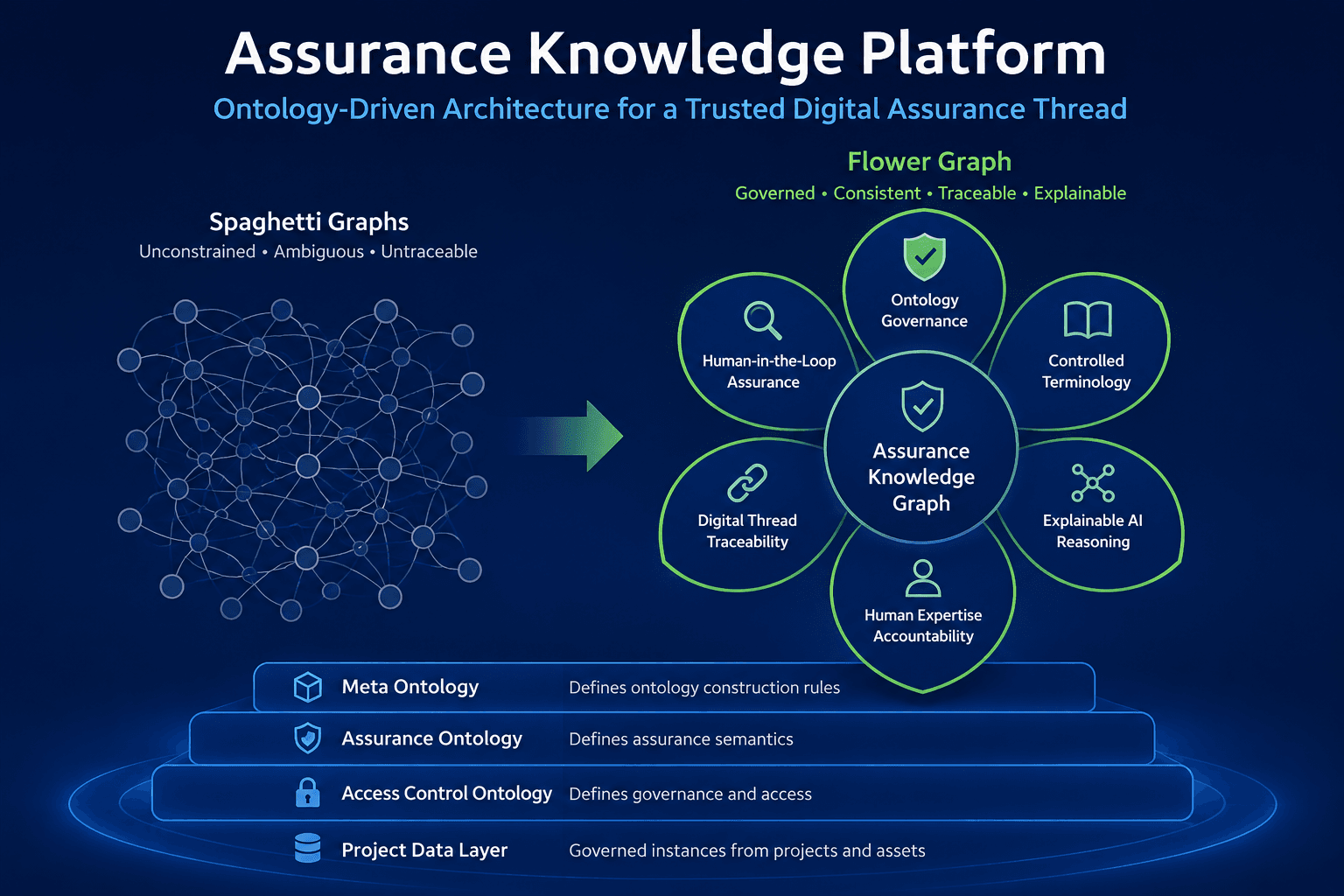
Assurance Knowledge Platform
Ontology Architecture Specification
Version 1.0 (Conceptual Architecture)
Author's Vision
This specification defines an ontology-driven knowledge platform intended to support assurance, quality management, information management, asset management and digital thread traceability across regulated built environment and infrastructure projects.
The architecture is designed to support:
- ISO 9000 / 9001 Quality Management
- ISO 55000 / 55001 Asset Management
- ISO 19650 Information Management and BIM
- Building Safety Act Golden Thread principles
- GraphRAG and Knowledge Graph applications
- Human-in-the-loop assurance workflows
- AI-assisted reasoning with explainable traceability
Appendix A — Assurance Knowledge Platform: Governance, Change and Evidence Principles details how this architecture can operate, keeping this specificastion focused on the structure and semantics of the Assurance Knowledge Platform.
1. Problem Statement
Many Knowledge Graph and GraphRAG implementations rely upon unconstrained extraction of triplets from documents:
Document
    ↓
Chunking
    ↓
LLM Extraction
    ↓
Triplets
    ↓
Graph
While suitable for general knowledge discovery, this approach often produces:
- Ambiguous terminology
- Inconsistent semantics
- Duplicate concepts
- Hallucinated relationships
- Weak traceability
The result is frequently a large, highly connected but poorly governed graph.
This document refers to such structures as:
Spaghetti Graphs
A Spaghetti Graph may contain many relationships but provides limited assurance value because the semantic meaning of nodes and relationships is inconsistent.
2. Design Objective
The objective is to create a graph structure that supports:
- Explicit semantics
- Controlled vocabulary
- Human-governed knowledge extraction
- Digital Thread traceability
- Explainable AI reasoning
The target architecture is referred to as a:
Flower Graph
Characteristics include:
- Strong ontology governance
- Consistent terminology
- Controlled relationship types
- Clear traversal paths
- Human review of extracted knowledge
- Lifecycle traceabilit
Example:
Requirement
    ↓
Design Output
    ↓
Verification Record
    ↓
Evidence
    ↓
Certification
Every path has assurance meaning.
3. Architectural Principles
Principle 1: Ontology Creates the Graph
Documents do not define graph structure.
Ontologies define graph structure.
Documents populate graph instances.
The extraction process must therefore answer:
Can this information instantiate an existing ontology definition?
rather than:
What new concepts can be invented?
Principle 2: Human-in-the-Loop Assurance
Knowledge extraction should support:
Document
    ↓
Candidate Objects
    ↓
Human Review
    ↓
Approved Graph
This significantly reduces semantic drift and hallucinations.
Principle 3: Traceability Before Discovery
The primary objective is not knowledge discovery.
The primary objective is:
Assurance Traceability
The platform shall support traversal across:
Requirements
Design
Construction
Verification
Validation
Certification
Operations
Maintenance
Renewal
Principle 4: Everything Must Be Explainable
Every graph relationship should be explainable through a governed ontology.
Questions such as:
Why is this requirement satisfied?

Why was access denied?

Why is this certificate valid?
must be answerable through graph traversal.
4. Multi-Layer Ontology Architecture
The platform consists of four logical layers.
Meta Ontology
        ↑

Assurance Ontology
        ↑

Access Control Ontology
        ↑

Project Data Layer
5. Meta Ontology
Purpose
The Meta Ontology defines the ontology construction language.
It describes how ontologies themselves are built.
Root Structure
Ontology
│
├── Ontology_Domain
├── Ontology_Concept
├── Ontology_Lifecycle_Stage
├── Ontology_Process
├── Ontology_Entity
├── Ontology_Relation
├── Ontology_Property
└── Ontology_Pattern
This Meta Ontology becomes a self-describing schema repository stored entirely inside a Graph Database.
6. Ontology Definitions
Ontology
Represents an ontology.
Examples:
Meta Ontology

Assurance Ontology

Access Control Ontology
Ontology_Domain
Represents a management discipline or capability area.
Examples:
Requirements Management

Asset Management

Information Management

Design Assurance

Risk Management

Configuration Management

Access Control
Questions answered:
Which business domain does this belong to?
Ontology_Concept
Represents abstract meaning.
Examples:
Requirement

Evidence

Conformance

Risk

Objective

Stakeholder

Competence

Information

Value
Questions answered:
What does this mean?
Ontology_Lifecycle_Stage
Represents a phase or state.
Examples:
Project Lifecycle
Concept

Definition

Design

Construction

Commissioning

Operations

Decommissioning
Asset Lifecycle
Planning

Acquisition

Operation

Maintenance

Renewal

Disposal
Questions answered:
When does something occur?
Ontology_Process
Represents activities or business processes.
Examples:
Verification

Validation

Design Review

Testing

Inspection

Audit

Commissioning

Condition Assessment

Change Control
Questions answered:
How is something performed?
Ontology_Entity
Represents things that may exist in data.
Examples:
Asset

Requirement

Certificate

Document

Verification_Record

Inspection_Record

Maintenance_Record

Organisation

Person
Questions answered:
What exists?
Ontology_Relation
Represents permitted relationship types.
Examples:
SATISFIES

VERIFIES

EVIDENCES

DERIVES_FROM

PART_OF

APPROVES

OPERATES

MAINTAINS

CERTIFIES
Questions answered:
How may things connect?
Ontology_Property
Represents reusable property class definitions.
Questions answered:
What attributes may be recorded?
Ontology_Pattern
Represents reusable graph structures.
Examples:
Requirement Verification Pattern

Certification Pattern

Maintenance Evidence Pattern
Questions answered:
What reusable structure exists?
7. Standard Property-Class Model
Ontology_Property nodes should represent property definitions rather than simple descriptions.
Recommended structure:
{
  "property_id": "PROP-0001",
  "name": "Requirement_ID",
  "display_name": "Requirement Identifier",
  "description": "Unique requirement reference",
  "data_type": "string",
  "mandatory": true,
  "unique": true,
  "indexed": true,
  "nullable": false,
  "default_value": null,
  "allowed_values": [],
  "validation_pattern": "^RQ-[0-9]+$",
  "unit": null,
  "minimum_value": null,
  "maximum_value": null,
  "version": "1.0",
  "status": "Approved"
}
This structure is:
- Graph friendly
- API friendly
- JSON serialisable
- GraphRAG friendly
- Validation friendly
8. Core Ontology Relationships
Meta Relationships
ONTOLOGY_CONTAINS

ONTOLOGY_RELATES_TO

ONTOLOGY_TYPE_OF

ONTOLOGY_PART_OF

ONTOLOGY_HAS_PROPERTY

ONTOLOGY_ALLOWS_RELATION

ONTOLOGY_HAS_PATTERN

ONTOLOGY_OCCURS_IN
Examples
Requirement
    HAS_PROPERTY
Requirement_ID

Verification_Record
    VERIFIES
Requirement

Inspection
    OCCURS_IN
Construction
9. Multiple Domain Membership
Ontology entities may belong to multiple domains.
Example:
Requirement
may belong to:
Requirements Management

Information Management

Configuration Management

Verification & Validation
This reflects the real-world nature of assurance information.
Ownership should not be restricted to a single domain.
10. Assurance Ontology
The Assurance Ontology is the primary business ontology.
Examples include:
Requirement

Asset

Verification_Record

Inspection_Record

Certificate

Maintenance_Activity

Information_Requirement

Design_Output
The Assurance Ontology shall be linked to the Meta Ontology through:
ONTOLOGY_TYPE_OF
11. Access Control Ontology
Access control is intentionally separate from assurance semantics.
The purpose of this ontology is to describe:
Identity

Role

Permission

Authority

Ownership

Classification

Policy
Examples:
Person

Role

Organisation

Permission

Security Classification
Example relationships:
HAS_ROLE

HAS_PERMISSION

OWNS

CAN_VIEW

CAN_EDIT

CAN_APPROVE
The Access Control Ontology shall also be linked to the Meta Ontology through:
ONTOLOGY_TYPE_OF
12. Project Data Layer
Project data contains actual records.
Examples:
RQ-001

AHU-101

VR-001

CERT-001

Inspection-824
The connection between project data and ontology elements is:
INSTANCE_OF
Example:
RQ-001
    INSTANCE_OF
Requirement

AHU-101
    INSTANCE_OF
Asset
13. Digital Thread Pattern
The core assurance pattern is traceability.
Example:
Requirement
    ↓ SATISFIED_BY

Design_Output
    ↓ VERIFIED_BY

Verification_Record
    ↓ SUPPORTED_BY

Evidence
    ↓ SUPPORTS

Certification
Equivalent chains exist for:
Asset Management

Operations

Maintenance

Information Management

Compliance
14. The Flower Graph Principle
The desired outcome is not maximum graph density.
The desired outcome is semantic clarity.
A Flower Graph exhibits:
Controlled vocabulary

Strong ontology governance

Clear traversal paths

Human-reviewed knowledge

Explainable relationships

Lifecycle traceability
The success criterion is not:
How many relationships exist?
The success criterion is:
Can the graph reliably answer:

"What evidence demonstrates that this
requirement has been satisfied throughout
the asset lifecycle?"
If that question can be answered transparently and consistently, the graph has achieved its assurance purpose.
15. Strategic Vision
The long-term vision is a self-describing knowledge platform in which:
- The Meta Ontology defines ontology construction rules.
- The Assurance Ontology defines assurance semantics.
- The Access Control Ontology defines platform governance.
- Project information populates the graph through governed instances.
- GraphRAG uses ontology-guided retrieval rather than unconstrained triplet extraction.
- Human experts remain accountable for assurance-critical knowledge.
The result is a trusted, explainable and traceable Digital Assurance Thread capable of supporting the complete lifecycle of regulated built assets and infrastructure.